


News
Scientists show how excess tau protein contributes to Alzheimer’s

Alzheimer’s disease is a brain disorder that causes neurons to die, slowly destroying memory and thinking skills.
It’s the most common type of dementia, impacting an estimated 50 million people worldwide, and is a particularly serious issue for Japan’s super-aged society.
Despite its prevalence, the causes remain poorly understood and treatment options are limited.
Now, a team of scientists in Japan has revealed how excess tau – a key protein implicated in Alzheimer’s disease – impairs signalling between neurons in the brains of mice.
The study, published recently in eLife, could open new pathways for treating the symptoms and even halting the progression of Alzheimer’s disease and other neurodegenerative disorders.
About tau
Tau is produced in neurons, where it binds to and promotes the assembly of microtubules – long, thin filaments that maintain cell structure and provide pathways for transport within the cell.
Tau usually exists in either this bound state, or it is dissolved in the liquid that fills the cell.
However, in some neurological disorders, most famously in Alzheimer’s disease, levels of soluble tau in certain brain regions become too high, and it aggregates into insoluble structures called neurofibrillary tangles.
“A lot of scientists focus on the impact of these visible neurofibrillary tangles that are a hallmark of Alzheimer’s, but actually, it’s the invisible levels of soluble tau that correlate most closely with cognitive decline,” said Professor Tomoyuki Takahashi, senior author of the study, and head of the Cellular and Molecular Synaptic Function Unit at OIST.
Mammalian brains
The research began ten years ago, when his team looked at the effect of high levels of soluble tau on signal transmission at the calyx of Held – the largest synapse in mammalian brains.
Synapses are the places where two neurons make contact and communicate.
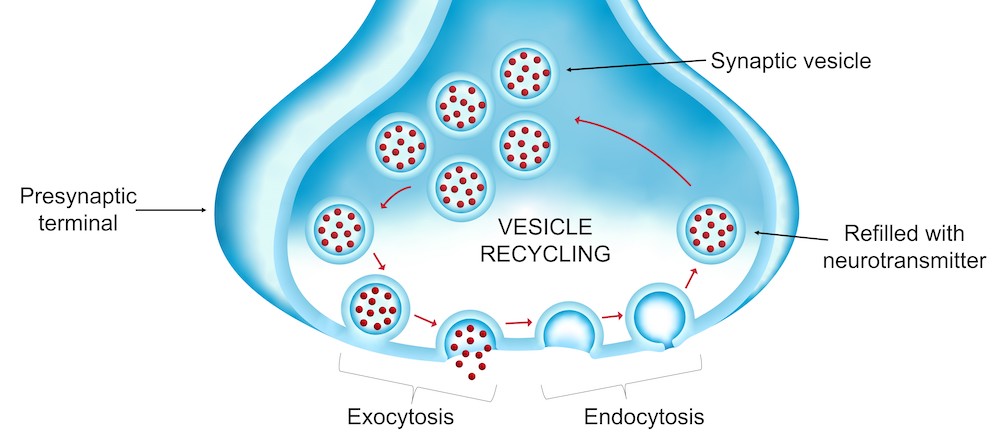
When an electrical signal arrives at the end of a presynaptic neuron, chemical messengers, known as neurotransmitters, are released from membrane ‘packets’ called vesicles into the gap between neurons.
When the neurotransmitters reach the postsynaptic neuron, they trigger a new electrical signal.
Using mice, Professor Takahashi’s research team injected soluble tau into the presynaptic terminal at the calyx of Held and found that electrical signals generated in the postsynaptic neuron dramatically decreased.
The scientists then fluorescently labelled tau and microtubules and saw that the injected tau caused new assembly of many microtubules in the presynaptic terminal.
No effect
However, when they injected a mutant tau protein instead that lacked the binding site necessary to assemble microtubules, there was no effect on synaptic transmission.
“This told us that the decrease in synaptic signalling was clearly linked to these newly assembled microtubules,” explained Professor Takahashi.
A second important clue was that elevated tau only decreased the transmission of high-frequency signals, while low-frequency transmission remained unchanged. High-frequency signals are typically involved in cognition and movement control.
The researchers suspected that such a selective impact on high-frequency transmission might be due to a block on vesicle recycling.
Vesicle recycling is a vital process for the release of neurotransmitters across the synapse since synaptic vesicles must fuse with the presynaptic terminal membrane, in a process called exocytosis.
These vesicles are then reformed by endocytosis and refilled with neurotransmitter to be reused.
If any of the steps in vesicle recycling are blocked, it quickly weakens high-frequency signals, which require the exocytosis of many vesicles.
Next step
The scientists found that high levels of soluble tau primarily impaired endocytosis. The lack of reformed vesicles impaired recycling and eventually slowed down exocytosis as a secondary effect.
Importantly, the researchers found that a drug called nocodazole, which blocks new microtubule assembly, prevented injected tau from impairing endocytosis.
The next step for the researchers was to figure out exactly how an excess of microtubules caused a block of endocytosis.
While searching for a link between microtubules and endocytosis, the team realized that dynamin, a large protein that cuts off vesicles from the surface membrane at the final step of endocytosis, was actually discovered as a protein that binds to microtubules, although little is known about the binding site.
When the scientists fluorescently labelled tau, microtubules and dynamin, they found that presynaptic terminals that had been injected with tau showed an increase of bound dynamin, preventing the protein from carrying out its role in endocytosis.
Normal level
Finally, the team created many peptides with matching sequences of amino acids to parts of the dynamin protein, to see if any of them could prevent dynamin from binding to the microtubules, and therefore rescue the signaling defects caused by tau protein.
When one of these peptides, called PHDP5, was injected along with tau, endocytosis and synaptic transmission remained close to a normal level.
Moving forward, the researchers plan to test this peptide in Alzheimer mouse models that have increased levels of soluble tau.
These mice lose their ability to learn and form new memories around six to eight months old, and the team hope that the peptide can prevent or reverse this memory impairment.
“To this end, we must modify PHDP5 so that it can penetrate the blood brain barrier. If this peptide works in these mice models, it can serve as an effective therapeutic tool for Alzheimer’s disease,” said Professor Takahashi.









People with diabetes may have undiagnosed heart failure that could be detected by a simple screening blood test, research suggests.
The TARTAN-HF trial found that one in four patients with diabetes who had at least one other risk factor for heart failure had undiagnosed heart failure detected through screening with a blood test and ultrasound scanning of the heart.
Experts said the findings show the extent of unrecognised heart failure in people with diabetes, and how the condition can be detected using a widely available blood test called NT-proBNP, which measures how much strain the heart is under.
They suggest a heart failure screening programme for diabetics could improve diagnosis rates, lead to earlier treatment and potentially reduce the risk of hospitalisation and death.
The study, involving 700 patients, was led by the University of Glasgow in collaboration with AstraZeneca, Roche Diagnostics, Us2.ai, NHS Greater Glasgow and Clyde and NHS Lanarkshire.
Dr Kieran Docherty, clinical senior lecturer at the University of Glasgow’s School of Cardiovascular and Metabolic Health, said: “Our results from the landmark TARTAN-HF trial identified heart failure in a large proportion of people living with diabetes, emphasising the need for a heart failure screening strategy in this group of patients.
“We know that many of the symptoms and signs of heart failure are non-specific, and may go unrecognised as potentially being due to heart failure for a long time.
“The strategy used in our trial is simple and easy to implement in clinical practice, and will aid in the early identification of heart failure in people with diabetes, and facilitate the initiation of medications that we know improve outcomes in patients with heart failure.”
The study, which began more than three years ago, involved more than 700 people with diabetes from the two health board areas who had at least one other risk factor for heart failure.
They were randomly assigned either to receive heart failure screening or to continue with their usual care.
Researchers found screening uncovered a large number of previously unrecognised cases of heart failure. Around one in four, or 24.9 per cent, of those screened were found to have the condition within six months, compared with 1 per cent in the group continuing their usual care.
The study, involving patients with type 1 and type 2 diabetes, found almost all of the participants found to have heart failure had preserved ejection fraction, which can be difficult to detect without dedicated testing.
The findings of the TARTAN-HF trial were presented at the American College of Cardiology conference taking place from 28 to 30 March in New Orleans in the US.
Dr Edward Piper, medical director at AstraZeneca UK, said: “Delayed diagnosis and treatment of heart failure in people with type 2 diabetes contributes to poor long-term outcomes. TARTAN-HF demonstrates that targeted, risk-based screening can identify previously undiagnosed heart failure in approximately one in four high-risk patients with diabetes, enabling earlier intervention with guideline-directed therapy.”
Dr Christian Simon, head of global medical affairs at Roche Diagnostics, said: “We are proud to have supported the landmark TARTAN-HF trial. These findings demonstrate the transformative power of early, accessible diagnostics like the NT-proBNP blood test.
“By identifying unrecognised heart failure in people with diabetes, we enable clinicians to initiate appropriate treatments sooner, ultimately improving patient outcomes and lives.”


The UK has launched a £6.3m men’s health fund to back local projects aimed at helping men and boys live longer, healthier lives.
The Men’s Health Community Fund is a partnership between the Department of Health and Social Care, Movember and People’s Health Trust.
The government is contributing £3m, while the two charities are more than doubling that to take the total to £6.3m.
Grants will support community projects reaching underserved men and boys aged 16 and over, particularly in the most disadvantaged areas and at key points in their lives such as becoming a father, losing a job or retiring.
Projects could include support for new fathers, activities for men facing loneliness and social isolation, services to help young men engage with the health system, and support for men in work, out of work and moving into retirement.
The programme will bring together voluntary, community and social enterprise organisations to test new ways of reaching men who are least likely to use traditional health services.
An evaluation funded through the National Institute for Health and Care Research will assess what works and help inform future policy and delivery.
Health and social care secretary Wes Streeting said: “Too many men across the country are living shorter, less healthy lives, particularly those in our most disadvantaged communities.
“This new partnership will help men get the support they need in the places they feel most comfortable, their communities, among people they trust.
“By working with expert charities and local organisations, we can reach the men who are too often missed by traditional services and help them take better care of their mental and physical health.”
“It is a key step in delivering our first ever Men’s Health Strategy and driving forward our ambition to halve the gap in healthy life expectancy between the richest and poorest areas.”
The Men’s Health Strategy sets out plans to tackle the physical and mental health challenges men and boys face.
Men can be less likely to seek help and more likely to suffer in silence, while higher rates of smoking, drinking, gambling and drug use are damaging men’s health and affecting families, workplaces and communities.
The government is also investing £3.6m over the next three years in suicide prevention projects for middle-aged men in local communities across areas of England where men are most at risk, many of which are also among the most deprived. Suicide is one of the biggest killers of men under 50, and three-quarters of all suicides are men.
The projects will aim to break down barriers middle-aged men face in seeking support, including stigma around asking for help and a lack of awareness of what is available and how to access it.
They will be co-designed with experts and men with lived experience of mental health crises and suicidal thoughts.

Gut-friendly foods may damage heart, charity warns

Diabetes patients face increased risk of undiagnosed heart failure

UK government announces £6.3m fund to boost men’s health

Brain health collaboratory launches in Gulf South
