Wellness
Michael J Fox Foundation grant awarded to research brain MRI biomarkers in PD

The Michael J Fox Foundation for Parkinson’s Research has awarded AI software developer Icometrix a grant to continue exploratory work into brain biomarkers for the disease.
The grant from the foundation, set up by the Back to the Future actor following his early onset Parkinson’s disease diagnosis in 1991 at the age of just 29, will support the development of a regulatory-cleared solution to automatically analysing brain MRI scans to improve monitoring of PD patients in clinical routine.
It will also help with patient selection and outcome assessment in multi-centre drug development trials.
The Icometrix research is being led in collaboration with co-principal investigator Kathleen Poston, a professor of neurology and neurological sciences at Stanford Medicine in California in the US.
This Parkinson’s disease-specific MRI solution will be added to the CE-marked and US Food and Drug Administration-cleared Icobrain portfolio of Icometrix, that also contains solutions for Alzheimer’s disease, multiple sclerosis, epilepsy, traumatic brain injury, and stroke.
Icobrain tracks brain volume changes to evaluate disease progression, providing precise and relevant change metrics.
Annemie Ribbens, VP science and trials at Icometrix, said: “PD monitoring is typically performed based on clinical scores that are subjective and do not allow for a fine-grained evaluation of disease characteristics. Early and specific prediction of the disease progression is therefore challenging.
“It also restricts our understanding of the underlying neurodegenerative pathophysiology and thereby hampers research on disease modifying therapies in an already highly diverse PD population.

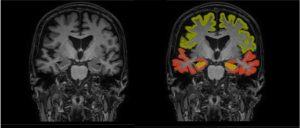
Dementia MRI with segmentation
“With this research, we aim to evaluate brain MRI patterns of PD patients that identify, early on, patients at risk for cognitive or motor problems.”
The first promising results of this project were presented at the Alzheimer’s Disease and Parkinson’s Disease Conference in Gothenburg, Sweden, in April 2023.
Brain MRI scans from Stanford and the Michael J Fox Foundation‘s landmark Parkinson’s Progression Markers Initiative (PPMI) – launched in 2010 to follow people, with and without PD, over time to learn more about how disease starts and changes – were evaluated in terms of volumetric patterns and correlated to corresponding clinical scores for motor and cognitive function.
The results show that regional brain volumetry assessment can serve as an important biomarker in prediction and differentiation of Parkinson’s disease patients at risk for motor and, or, cognitive disability progression.
Nearly 10 million people worldwide are living with Parkinson’s disease. The most common symptoms include motor problems such as shaking and stiffness, as well as difficulties with walking and balance.
In addition, approximately 30% of patients with Parkinson’s develop cognitive problems in the early stages of the disease, with a life-long risk of up to 80%.
However, Parkinson’s is extremely diverse with no two people experiencing the disease in the same way.
Icometrix – which has offices in both Leuven in Belgium and Boston in the US – says this highlights the need for a personalised prognosis and treatment approach.