


Wellness
Eldercare robot helps people sit and stand, and catches them if they fall

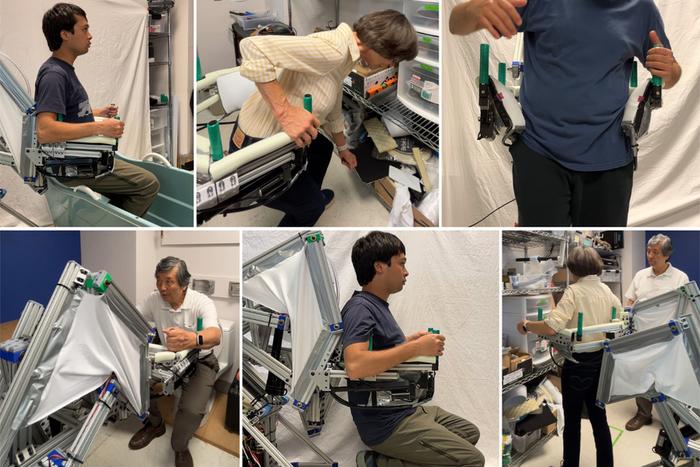
To help address the eldercare challenge, a team of MIT engineers is looking to robotics. They have built and tested the Elderly Bodily Assistance Robot, or E-BAR, a mobile robot designed to physically support the elderly and prevent them from falling as they move around their homes.
The United States population is older than it has ever been. Today, the country’s median age is 38.9, which is nearly a decade older than it was in 1980. And the number of adults older than 65 is expected to balloon from 58 million to 82 million by 2050.
The challenge of caring for the elderly, amid shortages in care workers, rising health care costs, and evolving family structures, is an increasingly urgent societal issue.
E-BAR
E-BAR acts as a set of robotic handlebars that follows a person from behind. A user can walk independently or lean on the robot’s arms for support. The robot can support the person’s full weight, lifting them from sitting to standing and vice versa along a natural trajectory. And the arms of the robot can them by rapidly inflating side airbags if they begin to fall.
With their design, the researchers hope to prevent falls, which today are the leading cause of injury in adults who are 65 and older.
“Many older adults underestimate the risk of fall and refuse to use physical aids, which are cumbersome, while others overestimate the risk and may not to exercise, leading to declining mobility,” said Harry Asada, the Ford Professor of Engineering at MIT.
“Our design concept is to provide older adults having balance impairment with robotic handlebars for stabilising their body. The handlebars go anywhere and provide support anytime, whenever they need.”
In its current version, the robot is operated via remote control. In future iterations, the team plans to automate much of the bot’s functionality, enabling it to autonomously follow and physically assist a user.
The researchers are also working on streamlining the device to make it slimmer and more manoeuvrable in small spaces.
“I think eldercare is the next great challenge,” says E-BAR designer Roberto Bolli, a graduate student in the MIT Department of Mechanical Engineering.
“All the demographic trends point to a shortage of caregivers, a surplus of elderly persons, and a strong desire for elderly persons to age in place. We see it as an unexplored frontier in America, but also an intrinsically interesting challenge for robotics.”
Bolli and Asada will present a paper detailing the design of E-BAR at the IEEE Conference on Robotics and Automation (ICRA) later this month.
Home support
Asada’s group at MIT develops a variety of technologies and robotic aides to assist the elderly. In recent years, others have developed fall prediction algorithms, designed robots and automated devices including robotic walkers, wearable, self-inflating airbags, and robotic frames that secure a person with a harness and move with them as they walk.
In designing E-BAR, Asada and Bolli aimed for a robot that essentially does three tasks: providing physical support, preventing falls, and safely and unobtrusively moving with a person. What’s more, they looked to do away with any harness, to give a user more independence and mobility.
“Elderly people overwhelmingly do not like to wear harnesses or assistive devices,” Bolli said.
“The idea behind the E-BAR structure is, it provides body weight support, active assistance with gait, and fall catching while also being completely unobstructed in the front. You can just get out anytime.”
The team looked to design a robot specifically for ageing in place at home or helping in care facilities. Based on their interviews with older adults and their caregivers, they came up with several design requirements, including that the robot must fit through home doors, allow the user to take a full stride, and support their full weight to help with balance, posture, and transitions from sitting to standing.
The robot consists of a heavy, 220-pound base whose dimensions and structure were optimised to support the weight of an average human without tipping or slipping.
Underneath the base is a set of omnidirectional wheels that allows the robot to move in any direction without pivoting, if needed. (Imagine a car’s wheels shifting to slide into a space between two other cars, without parallel parking.)
Extending out from the robot’s base is an articulated body made from 18 interconnected bars, or linkages, that can reconfigure like a foldable crane to lift a person from a sitting to standing position, and vice versa.
Two arms with handlebars stretch out from the robot in a U-shape, which a person can stand between and lean against if they need additional support. Finally, each arm of the robot is embedded with airbags made from a soft yet grippable material that can inflate instantly to catch a person if they fall, without causing bruising on impact.
The researchers believe that E-BAR is the first robot able to catch a falling person without wearable devices or use of a harness.
They tested the robot in the lab with an older adult who volunteered to use the robot in various household scenarios. The team found that E-BAR could actively support the person as they bent down to pick something up from the ground and stretched up to reach an object off a shelf – tasks that can be challenging to do while maintaining balance.
The robot also was able to lift the person up and over the lip of a tub, simulating the task of getting out of a bathtub.
Bolli envisions a design like E-BAR would be ideal for use in the home by elderly people who still have a moderate degree of muscle strength but require assistive devices for activities of daily living.
“Seeing the technology used in real-life scenarios is really exciting,” said Bolli.
In their current paper, the researchers did not incorporate any fall-prediction capabilities in E-BAR’s airbag system. But another project in Asada’s lab, led by graduate student Emily Kamienski, has focused on developing algorithms with machine learning to control a new robot in response to the user’s real-time fall risk level.
Alongside E-BAR, Asada sees different technologies in his lab as providing different levels of assistance for people at certain phases of life or mobility.
“Eldercare conditions can change every few weeks or months,” Asada said. “We’d like to provide continuous and seamless support as a person’s disability or mobility changes with age.”
This work was supported, in part, by the National Robotics Initiative and the National Science Foundation.









People with diabetes may have undiagnosed heart failure that could be detected by a simple screening blood test, research suggests.
The TARTAN-HF trial found that one in four patients with diabetes who had at least one other risk factor for heart failure had undiagnosed heart failure detected through screening with a blood test and ultrasound scanning of the heart.
Experts said the findings show the extent of unrecognised heart failure in people with diabetes, and how the condition can be detected using a widely available blood test called NT-proBNP, which measures how much strain the heart is under.
They suggest a heart failure screening programme for diabetics could improve diagnosis rates, lead to earlier treatment and potentially reduce the risk of hospitalisation and death.
The study, involving 700 patients, was led by the University of Glasgow in collaboration with AstraZeneca, Roche Diagnostics, Us2.ai, NHS Greater Glasgow and Clyde and NHS Lanarkshire.
Dr Kieran Docherty, clinical senior lecturer at the University of Glasgow’s School of Cardiovascular and Metabolic Health, said: “Our results from the landmark TARTAN-HF trial identified heart failure in a large proportion of people living with diabetes, emphasising the need for a heart failure screening strategy in this group of patients.
“We know that many of the symptoms and signs of heart failure are non-specific, and may go unrecognised as potentially being due to heart failure for a long time.
“The strategy used in our trial is simple and easy to implement in clinical practice, and will aid in the early identification of heart failure in people with diabetes, and facilitate the initiation of medications that we know improve outcomes in patients with heart failure.”
The study, which began more than three years ago, involved more than 700 people with diabetes from the two health board areas who had at least one other risk factor for heart failure.
They were randomly assigned either to receive heart failure screening or to continue with their usual care.
Researchers found screening uncovered a large number of previously unrecognised cases of heart failure. Around one in four, or 24.9 per cent, of those screened were found to have the condition within six months, compared with 1 per cent in the group continuing their usual care.
The study, involving patients with type 1 and type 2 diabetes, found almost all of the participants found to have heart failure had preserved ejection fraction, which can be difficult to detect without dedicated testing.
The findings of the TARTAN-HF trial were presented at the American College of Cardiology conference taking place from 28 to 30 March in New Orleans in the US.
Dr Edward Piper, medical director at AstraZeneca UK, said: “Delayed diagnosis and treatment of heart failure in people with type 2 diabetes contributes to poor long-term outcomes. TARTAN-HF demonstrates that targeted, risk-based screening can identify previously undiagnosed heart failure in approximately one in four high-risk patients with diabetes, enabling earlier intervention with guideline-directed therapy.”
Dr Christian Simon, head of global medical affairs at Roche Diagnostics, said: “We are proud to have supported the landmark TARTAN-HF trial. These findings demonstrate the transformative power of early, accessible diagnostics like the NT-proBNP blood test.
“By identifying unrecognised heart failure in people with diabetes, we enable clinicians to initiate appropriate treatments sooner, ultimately improving patient outcomes and lives.”

The UK has launched a £6.3m men’s health fund to back local projects aimed at helping men and boys live longer, healthier lives.
The Men’s Health Community Fund is a partnership between the Department of Health and Social Care, Movember and People’s Health Trust.
The government is contributing £3m, while the two charities are more than doubling that to take the total to £6.3m.
Grants will support community projects reaching underserved men and boys aged 16 and over, particularly in the most disadvantaged areas and at key points in their lives such as becoming a father, losing a job or retiring.
Projects could include support for new fathers, activities for men facing loneliness and social isolation, services to help young men engage with the health system, and support for men in work, out of work and moving into retirement.
The programme will bring together voluntary, community and social enterprise organisations to test new ways of reaching men who are least likely to use traditional health services.
An evaluation funded through the National Institute for Health and Care Research will assess what works and help inform future policy and delivery.
Health and social care secretary Wes Streeting said: “Too many men across the country are living shorter, less healthy lives, particularly those in our most disadvantaged communities.
“This new partnership will help men get the support they need in the places they feel most comfortable, their communities, among people they trust.
“By working with expert charities and local organisations, we can reach the men who are too often missed by traditional services and help them take better care of their mental and physical health.”
“It is a key step in delivering our first ever Men’s Health Strategy and driving forward our ambition to halve the gap in healthy life expectancy between the richest and poorest areas.”
The Men’s Health Strategy sets out plans to tackle the physical and mental health challenges men and boys face.
Men can be less likely to seek help and more likely to suffer in silence, while higher rates of smoking, drinking, gambling and drug use are damaging men’s health and affecting families, workplaces and communities.
The government is also investing £3.6m over the next three years in suicide prevention projects for middle-aged men in local communities across areas of England where men are most at risk, many of which are also among the most deprived. Suicide is one of the biggest killers of men under 50, and three-quarters of all suicides are men.
The projects will aim to break down barriers middle-aged men face in seeking support, including stigma around asking for help and a lack of awareness of what is available and how to access it.
They will be co-designed with experts and men with lived experience of mental health crises and suicidal thoughts.

Gut-friendly foods may damage heart, charity warns

Diabetes patients face increased risk of undiagnosed heart failure

UK government announces £6.3m fund to boost men’s health

Brain health collaboratory launches in Gulf South
